Arborvitae
Thuja occidentalis / 'Green Giant'
Family Cupressaceae
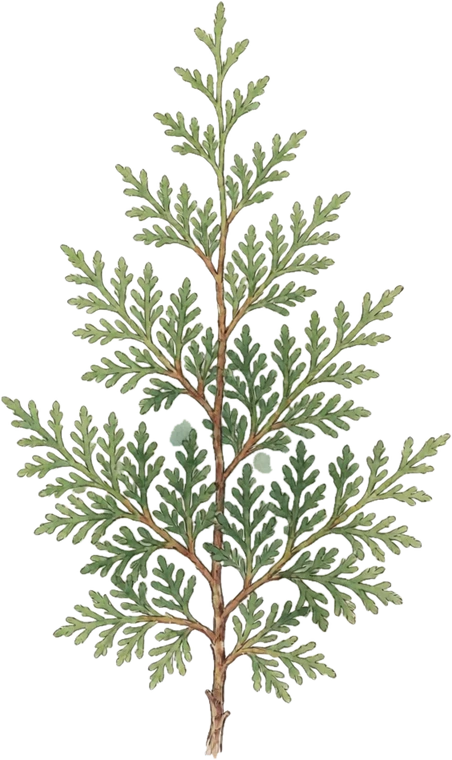
America plants arborvitae when it wants privacy by Friday — dense, soft, evergreen walls that never drop their screen. 'Green Giant' puts on three feet a year on its way to a genuine tree; 'Emerald Green' stays a slim twelve-to-fifteen-foot column that fits a suburban lot line.
It's a native conifer that gives songbirds year-round cover, and the honest match matters: 'Emerald Green' where deer are few — they consider it a buffet — and 'Green Giant' only where a fifty-foot future is welcome. Choose by those two truths and plant your fence once.
 Full Sun to Light Shade
 Moderate water
 'EG' slow-moderate growth
 Native to North America
From the print shop
Growing arborvitae? Hang it.
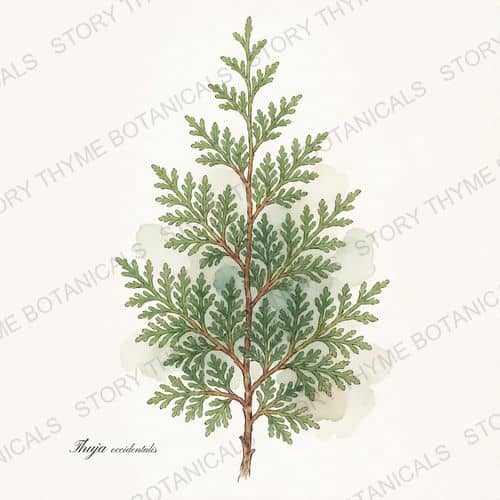
Our Plant Library collection carries arborvitae — Thuja occidentalis, print Nº 28, “Arborvitae.”
526 designsfrom $12.99white or black backgroundmatte poster, unframed
Will it thrive where you are?
Enter your ZIP — we look up your USDA hardiness zone (2023 map) and check it against what arborvitae actually needs.
 Hardy inZones 3-8
Arborvitae · Common problems
Common arborvitae problems

Pests
3 problems on file
- DEER (Thuja occidentalis is deer candy — 'Green Giant' is largely skipped)
- Bagworms
- Spider Mites

Diseases
5 problems on file
- Winter Burn (windy z4-5 sites)
- Root Rot in swamps
- Phomopsis Blight
- Winter Burn
- Transplant Shock
Arborvitae · Growing & propagation
Growing arborvitae
- Light
- Full Sun to Light Shade
- Water
- Moderate
Shallow roots want mulch + establishment watering
 Soil
Soil- Moist, drained
Tolerates clay + limestone · pH 6.0 - 8.0
 Fertilizer
- Spring evergreen feed if pushing growth
 Pruning
- Light shaping early summer; never into bare interior wood
Tie multi-leader tops loosely before wet snows (splay damage); one annual light shear keeps hedges tight.
 Spacing
- 3 ft
'Emerald Green' hedge) / 8-10 ft ('Green Giant'
How to plant & propagate arborvitae
- Propagate
- Seed (stratify), cuttings, or layering
Arborvitae · Seasonal care & spray guidance
The arborvitae growing playbook
When to spray arborvitae
Growing season. Deer country decision tree: fence it, spray it monthly, or plant 'Green Giant'/spruce instead.
Arborvitae · Calculators & field guides
A little help in the garden.
Arborvitae · Yearly calendar
The arborvitae year, month by month
Jan
No calendar activity is listed for this month.
PrunePruneJune
What each band means
- Prune — shape it now — cuts heal cleanly and structure is visible.
These are the species' typical months — expect them a few weeks earlier in warm zones and later in cold ones. Watch the plant, not just the calendar.
Arborvitae · Ecology & uses
Ecology & uses
Thuja occidentalis / 'Green Giant'
Arborvitae in the garden system
 Attracts
- Birds
 Habitat
- Dry/rocky
- Moisture
- Facultative / average
 Deer
Deer- Browsed
Protect young plants
- Origin
- Native to North America
What arborvitae is grown for
! Some parts toxic — see notesMildly toxic to pets
 Use
Use- Privacy hedges
- Use
- Windbreaks
- Use
- Screening
Edibility, identification, and traditional-use notes here are general reference — not medical or veterinary advice, and not a claim that any plant treats or prevents anything. Medicinal ratings record how strongly a plant features in herbal tradition, nothing more. Never eat or dose a plant you have not positively identified. More on how to use this library.
Arborvitae · Varieties & cultivars
Choosing a arborvitae variety
'Emerald Green' (the 15-ft privacy column of America); 'Green Giant' (fast, deer-resistant, BIG); 'Techny' (cold-iron)
Sources & plant identity
Know what you’re growing.
See where the knowledge comes from.
Arborvitae
Thuja occidentalis / 'Green Giant'
The plant, at a glance.
- Botanical name
- Thuja occidentalis / 'Green Giant'
- Plant family
- Cupressaceae
- Growth habit
- Tree · Perennial
- Origin
- Native to North America
- USDA plant symbol
- THOC2
- Invasive risk
- Low
Hardiness, size and timing vary with your cultivar, soil and climate.
Rooted in research.
University extension research, brought together with hands-on growing experience at Story Thyme Farms.
Questions
Arborvitae questions, answered straight.
Is arborvitae safe for kids and pets?
With care. Mildly toxic to pets Site it accordingly if children or pets roam the garden. This is general reference, not medical or veterinary advice — call a vet or poison control if something has actually been eaten.
How do you propagate arborvitae?
Seed (stratify), cuttings, or layering.
Elsewhere
Where arborvitae sits in the library.
 Sunflower
 Zinnia
 Peony
Peony Daylily