Plum
- Hardiness
- 5-9
- Mature size
- 12-15 ft
- Growth rate
- Moderate-Fast
- Chill requirement
- 500-1000
- Bloom season
- Early Spring
- Harvest season
- August - September
Family Rosaceae
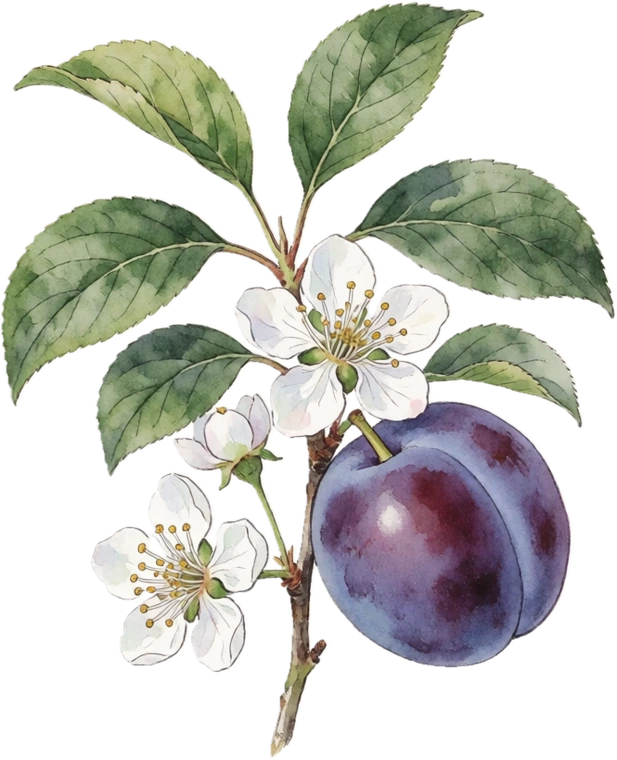
Few fruits swing from tart skin to honeyed flesh in one bite the way a plum does — jam-makers plan whole shelves around it. This entry covers both the orchard plum and the American wild plum, a native that trades size for perfume and old-fence-row charm.
Between the two types there is a plum for nearly any yard — hardiness runs from zone 3 to 9 across them — and both open the spring in clouds of white bloom. Plums want a pollination partner, so plan on a pair and let them keep each other honest.
 Full Sun
 Excellent edible
 Needs a pollination partner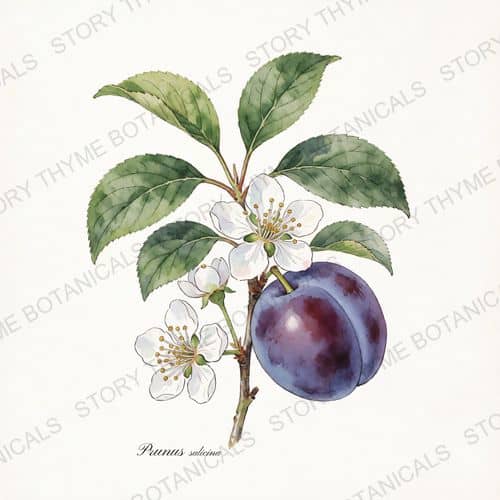
From the print shop
Our Plant Library collection carries plum — Prunus salicina, print Nº 371, “Plum.”
526 designsfrom $12.99white or black backgroundmatte poster, unframed
Hardiness differs across the 2 plums in this guide, so pick yours and this panel answers for that one.
Plum
Plum · Common problems
Poor pollination → low fruit set (plant a partner)
Plum · Which one do you have?
Where these differ, the key facts above give the span across all of them. Each type’s own figures, as the catalogue records them:
Plum · Growing & propagation
Light Propagate
Seed won't come true
Plum · Harvest & keeping
 Years to first harvestTypical yieldWhat you eat
 How to tell it is ready
Ripe plums often show waxy bloom
 How long it keeps
Preserves well
Plum · Seasonal care & spray guidance
winter, before growth starts
3 jobs PruningIn February and MarchPlum
In February or March, while the tree is dormant and temperatures are below freezing, find the hard black swollen galls on twigs and branches and cut at least 4 inches below each one, back into clean wood. Carry the cut wood out of the orchard and burn, bury, or bag it - do not leave prunings on the ground. The fungus Apiosporina morbosa overwinters alive inside the gall and fires spores at young shoots during spring rains, so a gall left on the ground or in a brush pile keeps infecting the tree it came from. Cutting well below the knot matters because the fungus grows inside the branch further than the visible swelling.
PruningIn February and MarchAmerican Wild PlumWhile the tree is bare and still freezing, find the black, cracked, charcoal-looking swellings on twigs and limbs and cut at least 4 inches below each one, back into clean wood. Carry the prunings off the site and burn or bury them, and cut the knots out of any wild plum or chokecherry thicket within throwing distance. The knots are the fungus itself, and they pump out spores every spring rain until they are gone; prunings left lying under the tree keep releasing spores as if they were still attached, and wild Prunus in the fencerow reinfects the tree you just cleaned.
PruningIn February and MarchAmerican Wild PlumPrune after the coldest weather has passed but before growth begins. Train to an open center, vase-shaped, cutting close to the branch collar and taking out crossing and inward-growing wood so light and wind reach the middle of the tree. Wild plum and its hybrids throw long, upright branches with few laterals, and a closed canopy stays wet after rain, which is exactly what brown rot and black knot need to infect.
early spring
5 jobs FeedingIn springPlum
In spring, measure last season's new shoot growth before reaching for fertilizer. A young plum should put on 10 to 20 inches of new shoot each year and an established tree 8 to 10 inches. If it is falling short, spread a half cup to a cup of 20-0-0 around the dripline of a young tree, or 1 to 2 cups for a tree five years or older. If growth is on target or excessive, apply nothing. Nitrogen is nearly always the only nutrient a plum lacks, and shoot extension is the tree's own honest report on whether it has enough. Overfeeding buys soft vigorous wood that is more attractive to aphids and slower to harden off for winter, and it costs you fruit.
PruningIn March and AprilPlumRemove dead damaged and crossing wood after the coldest weather passes; keep the center open for sun and airflow. Open growth reduces brown rot pressure and helps ripen fruit evenly.
 SprayingAt green tipPlum
On plum, spray horticultural oil at the green cluster stage, after buds break but before bloom, at a 2 percent rate, using the dilution your product's label gives for it. Cover the bark and crotches thoroughly; the oil only works where it lands. Oil kills San Jose scale, aphid eggs, and mite eggs by smothering them while they are exposed on the bark and before leaves shelter them. Once the canopy fills in, coverage of overwintering stages becomes impossible.
SprayingAt green tipPlumBegin fungicide applications when the flower buds are just starting to open, using captan, chlorothalonil, thiophanate-methyl, or lime sulfur, and repeat per the label until the new shoots have matured and hardened off. Spores are shed from last year's knots during spring rains and infect young green shoots and wounded branches, which is why the spray has to be running before the new growth is out and why fresh pruning cuts made in wet spring weather are an open door. Once shoot growth hardens, susceptibility drops and spraying stops paying.
SprayingAt green tipAmerican Wild PlumOn a tree with a history of knots, begin fungicide when the flower buds are just beginning to open, using captan, chlorothalonil, thiophanate-methyl or lime sulfur, and continue on the label interval until the new shoots harden off and the weather turns consistently warm and dry. Black knot spores are shot out of old knots during spring rains and can only infect the current season's green shoots, so the whole spray program is about protecting that soft new wood while it is still soft.
at bloom
2 jobsSprayingAt bloomPlumStart a fungicide when the first blossoms open, using myclobutanil, propiconazole, chlorothalonil, captan, or sulfur, and repeat per label through petal fall. Monilinia spores infect through the open flower, and the blighted blossom becomes the base camp from which the fungus moves into the spur and twig and produces the spores that rot the fruit months later. Stopping it at bloom is what makes the summer manageable.
SprayingAt bloomAmerican Wild PlumIf the tree has rotted fruit before, spray a fungicide labeled for plum, captan, myclobutanil or propiconazole, when about a quarter of the flowers are open, then again 10 days after shuck fall and once more 10 days after that. Monilinia infects open flowers, and a blossom needs only about three hours of wetness near 70F to take the fungus in; the blighted flower then becomes a twig canker that seeds the fruit rot in August.
as the fruit sets
2 jobsSprayingAt shuck splitPlumOn stone fruit, time the plum curculio spray for shuck split, after the petals have dropped and the dried flower remnants are splitting off the young fruit. Kaolin clay (Surround) is an option for home plantings. Repeat if warm weather continues, tightening the interval during peak activity, and pay extra attention to trees along a woods edge. The overwintered adults walk out of the leaf litter and hedgerows and cut crescent-shaped egg scars into the young fruit; the grub then tunnels the fruit centre and the fruit drops. The first few days above roughly 75F after petal fall are when the beetles are actually active and hittable - below 70F they barely move.
SprayingAt petal fallAmerican Wild PlumOnce three quarters or more of the petals have fallen and the fruit is around a quarter to a half inch, spray malathion or permethrin, or use kaolin clay for a non-insecticide option, and repeat on a 10 to 14 day interval. Trees next to woods need the follow-up most. The weevil overwinters in leaf litter at the woods edge, walks into the tree during bloom, and cuts a crescent-shaped slit in each young fruit to lay an egg - the first warm spell after petal fall, above about 70 to 75F, is when nearly all of that egg-laying happens. Mississippi State calls malathion the most effective material available to a homeowner for this weevil.
the growing season
4 jobsThinningIn May and JunePlumWhen fruitlets size up, hand-thin clusters so remaining plums have room to develop without limb breakage. Thinning improves fruit size and reduces broken branches on heavy-setting plum trees.
ThinningThrough summerAmerican Wild PlumOnce the danger of frost has passed, look at the crop load before you thin anything. American plum and most of its hybrids do not generally need thinning unless you want larger fruit - Alderman in particular carries a full load without help. If the tree is an overbearer like Waneta, or you want bigger plums, break up the clusters and thin to a single plum every 4 to 6 inches of branch, keeping the fruit nearer the trunk end of the limb. Utah State scopes the 4-to-6-inch spacing to European and Japanese plums and says American plums and American hybrids generally do not require it. But some of the hybrids do overset badly: the Wisconsin Carandale trial found Waneta over-fruits to the point that fruit size and quality drop off sharply, and a heavy load on the long branches of these trees breaks wood - while touching fruit in a cluster hands brown rot a bridge from one plum to the next.
PruningIn summerAmerican Wild PlumThrough the growing season, cut the shoots coming up from the roots off flush with the ground if you are training a single-trunk tree. If you want the thicket for wildlife cover and a hedge, leave them and let the colony fill in. Prunus americana suckers freely and will build a dense colony from its roots - that is how it lives in the wild, and it is a choice, not a defect, but a thicket is far harder to prune knots and curculio out of than a tree.
 What to watch forThrough summerAmerican Wild Plum
During the early fruit drop after petal fall, walk the tree at least twice a week and promptly collect every fallen plum, looking for the crescent-shaped scar. Destroy them - do not compost them under the tree. The larva rides the fruit to the ground and spends only about two to three weeks feeding inside it before exiting to pupate in the soil and emerge as the next generation of adults; picking the drops up promptly, before the larva leaves the fruit, breaks that generation instead of raising it.
as it ripens, and picking
2 jobsSprayingBefore harvestPlumStart fruit-rot sprays 2 to 3 weeks before harvest as the fruit begins to soften and colour, using captan, myclobutanil, propiconazole, or sulfur, and repeat per label right up to harvest. Green fruit is largely immune; susceptibility climbs steeply as sugars rise during ripening, which is why a clean tree can go to mush in the last fortnight. Warm wet weather in that window is what turns a few infections into a total loss.
SprayingBefore harvestAmerican Wild PlumBegin fungicide about one month before the plums start to color and repeat every 7 to 10 days through harvest, using a product labeled for plum such as captan. The second brown rot infection window opens as sugar rises in the ripening fruit - one rotted plum sporulates and takes the whole cluster down within days of picking weather.
autumn, and putting it to bed
2 jobsPruningAfter harvestPlumPick up fallen fruit through the summer and after harvest, and before bud break next spring strip every shrivelled mummy still hanging in the tree. Cut out twigs killed by brown rot and any cankered branches in February or March. Bury the infected fruit in a compost pile rather than tossing it under the tree. Mummies and cankers are where Monilinia overwinters - each one is a spore cannon aimed at next year's blossoms. Dropped, grub-infested fruit is also how plum curculio larvae reach the soil to pupate, so clearing drops cuts next season's beetle count.
What to watch forAfter harvestAmerican Wild PlumAfter harvest, pull every shriveled, hard, gray-fuzzed plum off the tree and rake up the ones on the ground, and cut out the twigs with sunken, gummy cankers. Finish before bud break next spring. The fungus overwinters in those mummies and in the infected wood, and they are the entire source of next spring's blossom blight - a mummy left hanging is next year's inoculum sitting directly above the flowers.
Plum · Calculators & field guides
Plum · Yearly calendar
No fixed season calendar for plum — its care follows conditions, not the calendar.
Plum · Ecology & uses
 Deer
DeerProtect young plants
! Some parts toxic — see notesPits toxic if crushed
Edible valueEdibility, identification, and traditional-use notes here are general reference — not medical or veterinary advice, and not a claim that any plant treats or prevents anything. Medicinal ratings record how strongly a plant features in herbal tradition, nothing more. Never eat or dose a plant you have not positively identified. More on how to use this library.
Plum · Varieties & cultivars
Named varieties of plum differ in winter-chill needs, ripening time, hardiness, and whether they set fruit on their own — pick one that fits your climate.
19 varieties
Self-fertile
sweet juicy red — Self-fertile low-chill Japanese plum
Story Thyme Farms may earn a small commission from these links, at no cost to you — it never changes what we recommend.
Also known as Stanley Prune
Self-fertile
sweet blue-purple prune, excellent fresh, dried, and canned — The most widely planted European prune-plum for home gardens: reliably self-fertile and productive across the North and Midwest.
Story Thyme Farms may earn a small commission from these links, at no cost to you — it never changes what we recommend.
Also known as Fellenberg, Italian, Empress-type prune
Self-fertile
rich sweet freestone, superb for drying and baking — Classic late-season self-fertile drying prune; needs a long warm season to ripen its deep flavor.
Story Thyme Farms may earn a small commission from these links, at no cost to you — it never changes what we recommend.
Also known as Reine Claude, Greengage
Partly self-fertile
honey-sweet amber dessert plum, considered among the finest fresh — Prized old-world dessert gage with unmatched flavor, but its high chill need makes it a poor choice for warm-winter regions. Often listed as self-fertile; 'partial' used conservatively.
Story Thyme Farms may earn a small commission from these links, at no cost to you — it never changes what we recommend.
Also known as Mt. Royal
Self-fertile
sweet blue freestone, good fresh and for canning — One of the hardiest self-fertile European plums, bred in Quebec and dependable where other European types winter-kill.
Story Thyme Farms may earn a small commission from these links, at no cost to you — it never changes what we recommend.
Also known as Damson, Shropshire Damson
Self-fertile
small, tart, astringent; a classic for jam, preserves, and wine — Tough, self-fertile heirloom grown for cooking rather than fresh eating; too tart to eat off the tree.
Story Thyme Farms may earn a small commission from these links, at no cost to you — it never changes what we recommend.
Partly self-fertile
juicy, sweet-tart crimson-skinned amber flesh, the benchmark fresh plum — The most popular Japanese plum: partially self-fruitful with moderate chill, adaptable from California to the mid-Atlantic.
Story Thyme Farms may earn a small commission from these links, at no cost to you — it never changes what we recommend.
Partly self-fertile
translucent yellow, very juicy and mild-sweet — Reliable early yellow plum that crops heavily, but plant a compatible pollinizer for dependable fruit.
Story Thyme Farms may earn a small commission from these links, at no cost to you — it never changes what we recommend.
Also known as Satsuma Blood Plum
Needs a pollinizer
dark red 'blood' flesh, sweet and rich, excellent for jam and fresh — Deep red-fleshed blood plum with rich flavor, but it sets almost nothing without a compatible pollinizer.
Story Thyme Farms may earn a small commission from these links, at no cost to you — it never changes what we recommend.
Also known as Bubblegum Plum
Partly self-fertile
spicy-sweet reddish flesh with a distinctive bubblegum aroma — Exceptionally cold-hardy American-Japanese hybrid; the University of Minnesota confirms it self-pollinates and is the go-to pollinizer for nearly every other hardy plum.
Story Thyme Farms may earn a small commission from these links, at no cost to you — it never changes what we recommend.
Needs a pollinizer
large red-skinned, firm sweet yellow flesh, excellent fresh — Large-fruited, very productive hardy hybrid for the Upper Midwest, but you must plant Toka or another pollenizer with it.
Story Thyme Farms may earn a small commission from these links, at no cost to you — it never changes what we recommend.
Also known as Gulfbeauty
Needs a pollinizer
sweet red-blushed yellow flesh, early ripening — University of Florida low-chill selection bred for the Deep South and disease pressure; plant a second Gulf-series tree for pollination.
Story Thyme Farms may earn a small commission from these links, at no cost to you — it never changes what we recommend.
Needs a pollinizer
sweet red Japanese-type plum — University of Florida low-chill release with a 95-day fruit development period, ripening mid-May in north-central Florida. Not self-fruitful - plant it with another Gulf variety.
Story Thyme Farms may earn a small commission from these links, at no cost to you — it never changes what we recommend.
Needs a pollinizer
sweet red-skinned Japanese-type plum — The latest of the Gulf series at about 275 chill hours and a 95-day fruit development period, extending the Florida plum season into late May. Its weaker plum leaf scald tolerance is the trade for that later date.
Story Thyme Farms may earn a small commission from these links, at no cost to you — it never changes what we recommend.
Needs a pollinizer
large, firm, sweet blue-skinned dessert plum — Vineland (Ontario) release, a cross of Imperial Epineuse and Grand Duke. Chill requirement has not been published, so treat it as a conventional European plum. Rated poor for black knot in the Maine trials and listed by Penn State among the most susceptible varieties, alongside Stanley - where black knot is endemic this tree needs the full dormant-pruning and green-tip fungicide program or it will not stay clean. Plant President instead if you want a late European plum that resists it.
Story Thyme Farms may earn a small commission from these links, at no cost to you — it never changes what we recommend.
Needs a pollinizer
firm blue-black plum, better cooked or preserved than fresh — The latest-ripening European plum on the Maine list, holding into October - only worth planting where autumn is long enough to finish it.
Story Thyme Farms may earn a small commission from these links, at no cost to you — it never changes what we recommend.
Needs a pollinizer
large-fruited Japanese plum — Vineland cross of Wickson and Burbank, and the latest Japanese plum in the Maine trials at mid-September. Named alongside Wickson and Early Golden as a good pollenizer for other Japanese varieties.
Story Thyme Farms may earn a small commission from these links, at no cost to you — it never changes what we recommend.
Needs a pollinizer
firm orange flesh, rich — Rated excellent for black knot and good for bacterial spot in the Maine trials - the cleanest Japanese plum on that list, which matters most where black knot is endemic.
Story Thyme Farms may earn a small commission from these links, at no cost to you — it never changes what we recommend.
Needs a pollinizer
sweet, slightly mealy yellow flesh — The earliest Japanese plum in the Maine trials, ripening late July. Flavor is sweet but the texture is slightly mealy, and it takes bacterial spot badly - grow it for the early date and for pollination, not for the fruit alone.
Story Thyme Farms may earn a small commission from these links, at no cost to you — it never changes what we recommend.
Sources & plant identity
Hardiness, size and timing vary with your cultivar, soil and climate.
University extension research, brought together with hands-on growing experience at Story Thyme Farms.
 Mississippi State University
 NC State Extension
 University of Illinois
 University of Maine
 University of Minnesota
 University of Missouri
 University of Wisconsin-Madison
 Utah State University
 University of Florida
Publisher marks identify sources, not sponsorship or endorsement.
Plum questions, answered straight.
Most often: it has no genetically distinct partner nearby. Plum is only partly self-fertile, so a lone plant sets a light crop at best — partially self-fertile in some types; the others need a genetically distinct partner nearby. Plant a second, unrelated one nearby; two different cultivars, or a cultivar plus a seedling, is the classic pairing.
With care. Pits toxic if crushed Site it accordingly if children or pets roam the garden. This is general reference, not medical or veterinary advice — call a vet or poison control if something has actually been eaten.
Grafted, or from cuttings/layering (seed won't come true).
Where plum sits in the library.
 Apple
Apple Peach
Peach Pluot
Pluot Cocktail Tree