American Holly
Ilex opaca
Family Aquifoliaceae
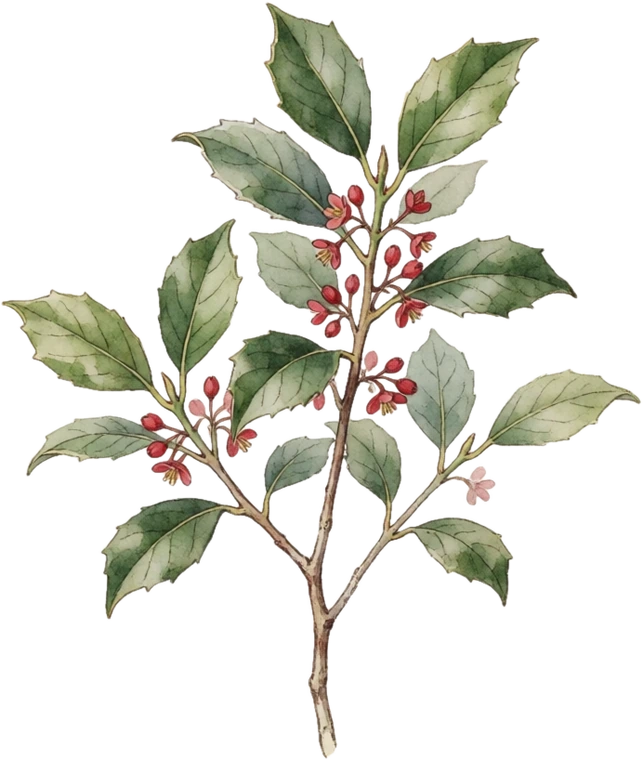
American holly is Christmas growing in the yard — the native evergreen whose spiny leaves and bright red winter berries defined the holiday card, rising as a stately pyramid of fifteen to forty feet. Cut a few boughs at the holidays and the mantel decorates itself.
Those berries carry birds through the leanest months, though they appear only on female trees with a male nearby — the classic pairing is a 'Jersey Knight' among 'Jersey Princess' hollies. They're bird food, not people food, so leave the snacking to the flocks. Plant the pair and screen in evergreen.
 Full Sun to Part Shade
 Moderate water
 Slow growth
 Native to North America
 Needs a pollination partner
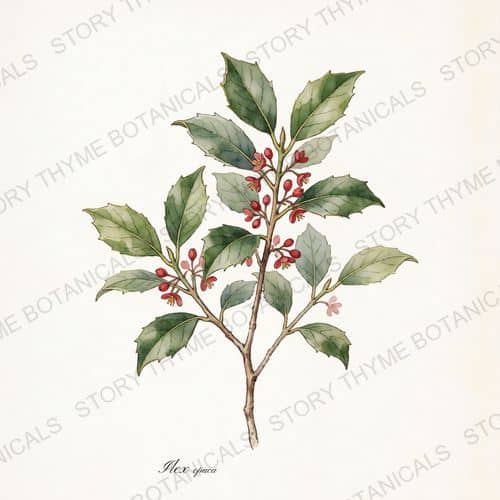
From the print shop
Growing american holly? Hang it.
Our Plant Library collection carries american holly — Ilex opaca, print Nº 15, “American Holly.”
526 designsfrom $12.99white or black backgroundmatte poster, unframed
Will it fruit where you are?
Enter your ZIP — we look up your USDA hardiness zone (2023 map) and check it against what american holly actually needs.
 Hardy inZones 5-9PollinationPartner needed
American Holly · Common problems
Common american holly problems

Pests
2 problems on file

Diseases
4 problems on file
Pollination
Poor pollination → low fruit set (plant a partner)
American Holly · Growing & propagation
Growing american holly
- Light
- Full Sun to Part Shade
- Water
- Moderate
Well-drained
 Soil
Soil- Acid, moist, well-drained · pH 5.0 - 6.0
 Fertilizer
- Acid feed lightly in spring
 Pruning
- Late Winter (cut boughs for holiday greenery)
Shear as a hedge or leave pyramidal; spiny leaves — wear gauntlets. Slow but long-lived.
 Spacing
- 15-20 ft
How to plant & propagate american holly
- Propagate
- Seed (stratify), cuttings, or layering
American Holly · Calculators & field guides
A little help in the garden.
American Holly · Yearly calendar
The american holly year, month by month
Jan
HarvestDecember to February
 BloomPrune
 Harvest
BloomMarch to May
PruneFebruary to March
HarvestDecember to February
What each band means
- Bloom — flowers open — pollinators working, frost on blossoms is the danger.
- Prune — shape it now — cuts heal cleanly and structure is visible.
- Harvest — picking time — check ripeness every few days.
These are the species' typical months — expect them a few weeks earlier in warm zones and later in cold ones. Watch the plant, not just the calendar.
American Holly · Ecology & uses
Ecology & uses
Ilex opaca
American Holly in the garden system
- Canopy layer tree
 Attracts
- Birds
 Habitat
- Dry/rocky
- Moisture
- Facultative / average
 Deer
Deer- Browsed
Protect young plants
- Origin
- Native to North America
What american holly is grown for
! Some parts toxic — see notesBerries toxic to people/pets (birds are fine — they're the point)
- Use
- Christmas greenery
- Use
- Evergreen screen
- Use
- Bird berries
- Use
- Native
Harvesting & storing american holly
Female trees: the classic red Christmas berries, feeding birds all winter.
Edibility, identification, and traditional-use notes here are general reference — not medical or veterinary advice, and not a claim that any plant treats or prevents anything. Medicinal ratings record how strongly a plant features in herbal tradition, nothing more. Never eat or dose a plant you have not positively identified. More on how to use this library.
American Holly · Varieties & cultivars
Choosing a american holly variety
'Jersey Princess' (female, glossy); 'Jersey Knight' (male pollenizer); 'Dan Fenton' — need one male for berries
Sources & plant identity
Know what you’re growing.
See where the knowledge comes from.
American Holly
Ilex opaca
The plant, at a glance.
- Botanical name
- Ilex opaca
- Plant family
- Aquifoliaceae
- Growth habit
- Tree · Perennial
- Origin
- Native to North America
- USDA plant symbol
- ILOP
- Invasive risk
- Low
Hardiness, size and timing vary with your cultivar, soil and climate.
Rooted in research.
University extension research, brought together with hands-on growing experience at Story Thyme Farms.
for American Holly
Research from these sources

Publisher marks identify sources, not sponsorship or endorsement.
Questions
American Holly questions, answered straight.
Why isn't my american holly fruiting?
Most often: it has no genetically distinct partner nearby. American Holly can't pollinate itself — dioecious — need a male within ~50 ft to berry the females. Plant a second, unrelated one nearby; two different cultivars, or a cultivar plus a seedling, is the classic pairing.
Is american holly safe for kids and pets?
With care. Berries toxic to people/pets (birds are fine — they're the point) Site it accordingly if children or pets roam the garden. This is general reference, not medical or veterinary advice — call a vet or poison control if something has actually been eaten.
When do you harvest american holly?
Female trees: the classic red Christmas berries, feeding birds all winter.
How do you propagate american holly?
Seed (stratify), cuttings, or layering.
Elsewhere
Where american holly sits in the library.
 River Birch
 Southern Magnolia
 Ginkgo
 Colorado Blue Spruce